FAQs.
Lithium extraction Lithium
- Lithium-rich thermal water from the underground in the Upper Rhine Graben is pumped to the surface.
- The lithium is then extracted from the thermal water using direct lithium extraction by adsorption (A-DLE). This technology has been used commercially since the 1990s .
- More precisely, the hot thermal water containing lithium is channelled through a type of filter known as a sorbent. The lithium ions remain suspended in this sorbent – the remaining thermal water flows through it.
- The heat from the thermal water is used to drive the extraction process and to provide renewable heat and electricity. Once both the energy and the lithium have been extracted from the thermal water, it is fed back into the natural reservoir – a closed cycle.
- The extracted lithium is first purified in a lithium extraction plant. It is then transported in an aqueous lithium chloride solution to a lithium electrolysis plant, where it is processed into the end product lithium hydroxide monohydrate (LHM).
- The LHM is supplied to the automotive industry via cathode and battery cell manufacturers and used for the construction of electric vehicles or for renewable energy storage (solar and wind). At the end of the battery life cycle, the lithium can be recycled.
- A-DLE, short for Adsorption-type Direct Lithium Extraction, is a method of extracting lithium from brine.
- The market share for A-DLE currently sits at ca. 10% of global lithium production and is forecast to grow by 280% over the next ten years (source: Benchmark Minerals Intelligence), being the technology of choice for much of the industry going forward.
- A-DLE’s advantages over legacy extraction methods of lithium include lower operating costs, lower environmental impact, higher product quality, and a positive track record.
- VULSORB® is the proprietary lithium extraction technology that Vulcan uses to capture the lithium before the brine is returned to the subsurface.
- The aluminate-based sorbent has a higher performance and lower water consumption during lithium extraction compared to commercially available sorbents.
- VULSORB® can be used in Europe as well as in other brines worldwide.
- VULSORB® has been successfully tested with multiple brines, both in Europe and globally, and is available for licensing.
- Lithium extraction from hard rock: Hard rock mining lithium minerals is a very energy-intensive process. The minerals are usually mined at around 1% Li₂O, meaning that 99% of the mined material is waste. The ore is concentrated to around 5-6% Li₂O, before being transported long distances to refineries which are usually in China. This means that around 94-95% of the shipped material is usually waste. The refinery uses a roasting process, which uses large amounts of fossil fuels to produce lithium hydroxide.
- Lithium extraction through evaporation ponds: Lithium extraction from brines evaporates large quantities of water in some of the driest places on earth. It also has a significant CO₂ footprint, through large use of chemical reagents.
- Lithium or lithium salt itself is found in natural form in rock in several regions of Germany. In Vulcan’s process, the lithium salt is always contained within a closed circuit and therefore does not enter the environment.
- Whilst lithium is common in nature, and even prescribed for medical use, lithium is classified as a hazardous substance according to the Globally Harmonised System (GHS), which is responsible for the classification and labelling of chemicals. This is due to its reactivity, as well as the properties of some lithium compounds, which can be harmful to health in aqueous solution above certain concentrations. These harmful lithium compounds also include lithium salts.
- Risks only exist if dust from lithium salts occurs. The only process step in which this can occur takes place at the Industrial Park Höchst, Frankfurt, where LHM is produced. However, this is packaged in a chemically inactive atmosphere and transported safely to battery manufacturers.
- In the realm of energy storage and the shift to electromobility, lithium-ion batteries have undoubtedly established themselves as a reliable and efficient technology, providing crucial advancements in various applications. Their high energy density, long lifespan, and widespread availability make them a frontrunner in the battery and automotive industry.
- Vulcan is gearing up to become Europe’s leading sustainable lithium business and to enable energy security through geothermal energy, aiming to establish a domestic and green lithium supply in Europe, for Europe, to support the battery automotive industry in its EV transition.
- Commercial series production of battery electric vehicles (BEV) using sodium-ion-batteries as alternative to lithium-ion-batteries has begun. Vulcan believes there is a place for sodium batteries in the market. While lithium-ion batteries currently hold certain advantages, such as greater energy efficiency and a more mature technology base, sodium-ion batteries may showcase potential benefits, e.g. in terms of cost and resource availability. In the EV sector, sodium-ion batteries will typically be used for smaller vehicle with shorter driving ranges.
- Embracing technological diversity is key to fostering innovation and sustainability, ensuring that both technologies can coexist and contribute to the green EV transition.
- No. Lithium extraction is a physical process, which means that only a few reagents are required.
- As the entire process takes place in a closed circuit, no other substances bound in the brine can escape.
- The sustainability of lithium extraction at Vulcan has been comprehensively assessed by several independent studies.Two environmental studies based on life cycle assessments (LCA) were carried out by Minviro, a company specializing in raw material analysis, as part of the Pre‑Feasibility Study, the Definitive Feasibility Study, and the Bridging Engineering Study for Vulcan’s project.
- The results of the most recent study were published in the 2023 Sustainability Report (link).
These assessments show that Vulcan’s process has a significantly lower environmental impact compared to legacy methods
A key component of the process is the CO₂-neutral conversion of lithium chloride into lithium hydroxide monohydrate (LHM), which can be used directly in electric vehicle battery production - Vulcan has also carried out an Environmental Social Impact Assessment (ESIA), which is a prerequisite for raising sustainable debt finance and is an important third-party validation of forecasted environmental and social impacts. The ESIA considers the overall environmental and social impact of the project over its entire life cycle (construction, operation and dismantling). Vulcan conducted its first ESIA in 2023, which the Company updated and published in 2024 and 2025
- In October 2024, Vulcan’s Green Financing Framework was assessed by leading independent ratings agency, S&P Global Ratings, and awarded a Dark Green rating overall, the highest ever received by a Metals and Mining company globally. Vulcan was also awarded a Dark Green rating across the Green Enabling Project and Renewable Energy categories. S&P Global concluded the Framework aligns with third-party published sustainable finance principles, including the International Capital Market Association Green Bond Principles and Green Enabling Projects Guidance, and the Loan Market Association Green Loan Principles.
- Based on projections, Vulcan anticipates that lithium extraction can be undertaken economically for several decades, with heat production from each site lasting at least 50 years
- According to the current state of research, only limited options are available to ensure both efficient energy storage in batteries and a sustainable supply of green electricity and heat. In this context, the extraction of lithium is justified – especially as it already enables us to make a tangible contribution to reducing greenhouse gas emissions
- Geothermal energy remains a central component of sustainable energy supply. In some cities (e.g. Munich in Germany, Riehen in Switzerland), geothermal plants for electricity and heat generation are operated economically without lithium extraction at all.
- Yes, after lithium extraction, the brine still has a temperature of about 70°C. However, this residual heat is no longer used by Vulcan for energy and is returned to the reservoir with the thermal water. Reinjection closes the natural cycle, which is crucial for the geothermal sustainability and stability of the reservoir.
- At the upstream lithium extraction plant in Landau, Vulcan recovers the lithium in the form of a highly concentrated, pure aqueous lithium chloride solution. In this form, the lithium is not yet suitable for use in cathode for batteries, and needs to be converted into LHM (Lithium hydroxide monohydrate)
- This conversion takes place via an established process, chlor-alkali electrolysis, a process that has also been successfully used in the production of sodium hydroxide for decades. As this is a chemical process that produces chlorine as a by-product, which is converted to green HCl, the downstream LHM plant needs to be located in an appropriately permitted and serviced industrial park.
- The Industrial Park Höchst, Frankfurt, offers the necessary infrastructure, safety precautions and industrial partners who can purchase the resulting green HCl
- The lithium chloride is transported in a highly concentrated, liquid form (about 40% by weight), as this is the safest and most efficient way to transport larger quantities.
- To operate a plant that produces around 24,000 tonnes of lithium hydroxide annually, about ten trips per day are required. Each of these trucks’ transports around 27 tonnes of material.
Renewable energy through Erdwärme bzw. (Tiefen-) Geothermie
- The natural heat stored in the interior of the earth is used as an energy source. This heat is generated by various processes (e.g. by radioactive decay reactions in the Earth’s mantle and the transfer of heat from the Earth’s crust to the Earth’s surface)
- Geothermal energy can be used for heating, cooling and to generate electricity.
- The term “geothermal energy” is a generic term and refers to both near-surface and deep geothermal energy. The key difference between the two types lies in the depth of the drilling
- While near-surface geothermal energy uses geothermal energy from depths of up to 400 metres, deep geothermal projects involve drilling up to several kilometres below the Earth’s surface. The temperature rises with the increasing depth of the drilling
- As a result, heat from deep geothermal energy can supply entire neighbourhoods with heat or electricity, cooling or electricity, whereas heat from near-surface geothermal energy can only heat individual single-family homes and apartment buildings
- Vulcan utilises deep geothermal energy, as drilling up to 4 km underground is required to produce lithium from brine.
Deep geothermal energy in Germany has the potential to cover over a quarter of Germany’s heating requirements (source Fraunhofer 2022).
Advantages of deep geothermal energy include:
- Consistency: Geothermal energy is base-load capable and therefore available at all times. Other renewable energy sources are dependent on the day or weather
- High efficiency: Hardly any thermal energy is lost when heat is produced with geothermal energy
- Versatility: In addition to heat, geothermal energy can also generate electricity and cooling
- Unlimited supply: In contrast to fossil fuels, geothermal energy is inexhaustible
- Low space consumption: Compared to conventional oil or gas heating systems, geothermal connection stations in households are significantly smaller
- Climate friendly: When converting geothermal energy into electricity or heat, significantly less CO2 is produced compared to generating energy from coal and other fossil fuels, thus offering independence
- Regional value creation: There are opportunities for energy-intensive businesses to grow and thus there are higher trade tax revenues for municipalities.
Disadvantages of deep geothermal energy include:
- Cost intensity: The construction of a new geothermal plant is associated with high costs.
- Locally limited usability: Only a few regions in Germany have the necessary conditions for the use of geothermal energy
- High upfront capital cost: Complex preparatory work such as deep geothermal drilling, seismic measurements and approval procedures is often necessary to find the required temperature level in deeper layers of the earth
- Exploration risk: in new/unproven areas, risk of achieving an insufficient thermal water production rate and/or encountering an insufficient reservoir temperature when developing a geothermal reservoir.
- District heating systems are designed to be highly reliable, with very minimal annual downtime.
- High supply security is achieved through several layers of redundancy, such as:
- Mobile heating plants that can temporarily cover supply during planned maintenance or unexpected outages.
- Interconnected networks combining multiple heat generation sites. If one plant goes offline, others can take over to ensure continuous supply.
- The priority is the heat supply, especially during the heating season. However, district networks can also provide cooling and electricity where available. The actual distribution of heat, cooling, and electricity depends on local demand patterns and infrastructure conditions.
- No, in addition to lithium, sustainably generated heat is one of Vulcan’s central products and is an essential part of the holistic concept. The simultaneous extraction of lithium and the generation of heat and electricity from geothermal brine creates a particularly efficient and economical plant system
- This heat can be fed into municipal grids and thus contributes to the decarbonisation of the heat supply. This creates a double benefit from a single source: sustainable raw material extraction and heat generation.
- Vulcan’s scope of services is the production and provision of sustainable heat, electricity, cooling, and lithium from geothermal brine. The responsibility for expanding and operating local district heating networks remains with the regional energy providers, such as the municipal utilities.
- Vulcan’s project creates the technical foundation and supports the economic conditions for a climate‑friendly heating infrastructure at the municipal level. However, the financing of network expansion does not lie with Vulcan but with the responsible utility companies (e.g., ESW in Landau).
- Theoretically, the thermal water can be circulated indefinitely. Basically, nature has been doing this for a long time: hHt flows continuously from the earth’s interior and reheats the water. However, this process is slow. In practice, therefore, technical circulation is limited primarily by economic factors.
- For Vulcan, the lithium level in the thermal water also plays an economic role and affects how long the water is extracted and returned. This is why it is particularly important to closely monitor the extracted lithium values during lithium extraction. Vulcan continuously collects information on changes in reservoir parameters to enable efficient reservoir management. In this way, long-term and sustainable use for both heat production and lithium extraction is optimised.
- In addition, geothermal plants have proven their longevity. In Larderello, Italy, one of the world’s oldest plants has been running for over 100 years, and the oldest German plant in Waren an der Müritz has been operational since 1994.
- The underground water flows do not change in quantity, as all the extracted thermal water is completely returned to the same geological horizon (i.e. the same “floor”) after use – even after lithium extraction
- Lithium extraction takes place outside the underground system and does not affect the natural flow paths in the reservoir. It only changes the lithium content of the water – but not the underground cycle.
- Cooling is also possible via the district heating network. For this purpose, a special process called “absorption cooling” is used, which generates cold from heat – this allows buildings to be air-conditioned in summer.
Drilling site and drillings
- With the help of the data from the successfully completed 3D seismic survey, optimal locations for a geothermal borehole can be identified
- The locations are always selected in such a way that interference with nature and the influence on the environment are as low as possible.
- As soon as the well site is set up, the drilling rig is erected and the drill pipe is ready, the drilling begins.
- The standpipe is only 30 to 40 meters deep. Smaller tubes that are plugged into each other follow similar to a telescope. They are sealed against each other to protect the groundwater. The wells are then drilled vertically to a depth of around 1,000 metres before they are deflected and lead at an angle into the permeable reservoir
- During the drilling process, various experts are deployed to ensure that the drilling is carried out safely and to monitor the individual work steps. Once the desired end point of the well has been reached, several tests are carried out. Upon successful completion, the system is prepared for commissioning.
- The drilling site is built completely watertight to protect the surrounding area, especially the groundwater, from contamination.
- The site will be equipped with its own drainage system, which is independent of the public sewerage system. As in all commercial operations, wastewater is collected, analysed at regular intervals, and disposed professionally if necessary.
- A threat to groundwater from deep geothermal energy can be ruled out if it is carried out professionally
- All deep boreholes are subject to the strict operating plan procedure under mining law, which also considers the interests of the local population and environmental protection
- Particularly when drilling through drinking water-bearing layers, strict protection requirements must be met. These include the special selection of the drilling method, the drilling fluid (without water-polluting ingredients) and reliable, multiple casing and cementation to sustainably shut off the borehole from the drinking water horizon. All sealing areas are also continuously monitored by measuring equipment over the entire period of operation and their functionality is assessed at regular intervals by external experts
- In the immediate vicinity of the boreholes, several groundwater measurement gauges are installed for continuous groundwater monitoring. This is important in that it is then necessary to prevent the groundwater from spreading beyond the area of the drilling site, and in order to be able to take effective countermeasures in a timely and targeted manner
- The monitoring and the measures are co-ordinated with the water authority.
- By regularly monitoring various parameters in the drilling, defects can be recognised at an early stage.
- In addition, a network of measuring points in the near-surface aquifer can help to ensure that any seepage of brine into near-surface aquifers can be detected at an early stage and suitable countermeasures can be initiated.
- Chemically analysing the brine prior to commissioning also enables a detailed risk assessment to be carried out, allowing the monitoring concept to be adapted accordingly.
- The drilling does not create cavities that could collapse and cause subsidence on the surface.
- Brine is extracted from fissures and pores in the sandstone, where the diameter of the drilling decreases with increasing drilling depth.
- In contrast to mining and oil production, utilising deep geothermal energy does not involve permanent extraction of ground resources because the brine is channelled back into the same reservoir after the heat has been taken out.
- Fracking is only allowed in Germany for research purposes under strict conditions and is not used by Vulcan
- Fracking is often confused with so-called ‘hydraulic stimulation’. Fracking creates new cracks and thus pathways for groundwater in an otherwise dense structure. In hydraulic stimulation, existing cracks/ paths in the vicinity of the borehole are widened with pressure, thereby improving the hydraulic connection of the borehole to the groundwater-conducting formation
- The reservoirs for the thermal water on the Upper Rhine are located in particularly permeable rock layers (shell limestone and red sandstones), which makes fracking, which is used to open up impermeable rock layers, superfluous.
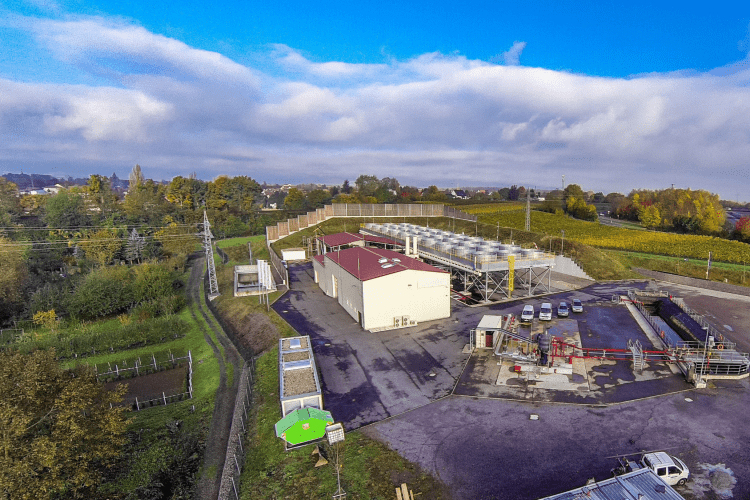
- A drilling site is about three hectares in size – the equivalent of about four football pitches. The surface is always structured in the same way, regardless of how many boreholes are drilled. This standardised layout makes it possible to also schedule reserve boreholes, which increases flexibility and secures the heat supply
- The drilling site contains the boreholes themselves, the technical systems for energy generation and heat exchangers through which the heat generated can be fed directly into a district heating network.
- Above the surface, the injection and production wells are only a few meters apart. At a depth of 3.5 km in the ground, they are about 1.5 km apart. This distance does vary and depends on where in the rock there are particularly well-permeable areas through which the thermal water can flow
- The basis for defining these zones is a geological 3D model derived from seismic measurements. In addition, computer simulations are used to calculate how the water behaves underground over a long period of time. This ensures that the system can be operated stably, efficiently and sustainably – as is the case at the Insheim site, for example, where such a distance has already been successfully implemented.
- A geothermal well is carried out in several sections to ensure the stability and tightness of the well
- After each drilling section, a steel pipe, the so-called casing, is installed and firmly connected to the surrounding rock with cement. This cementation prevents liquids from migrating uncontrollably between different geological layers. At the same time, cement and steel pipe protect the borehole from collapsing
- The structure is based on the structure of a telescope: in the upper area of the borehole are steel tubes with a large diameter. This diameter is reduced in the course of the drilling, so that ultimately four different pipe sizes are installed in the borehole
- Inside the borehole are special pipes, with both the production and injection pipes – technically designed to withstand heat and rust and not break due to the harsh conditions that arise during the life phase of a well
- If lithium is to be extracted from the thermal water, the technical structure of the plant can be more complex. Then, among other things, special heat exchangers and processes for material separation are used. Sometimes this requires additional, targeted drilling – all of which serves to make the best use of the heat and valuable raw materials.
The drilling depth is between 2.5 km and 4 km.
- Before each borehole, an elaborate geophysical preliminary exploration is required. This is necessary in order to plan the drill target and the necessary drill path. The preliminary exploration is then carried out to create a structural image of the subsoil. The depicted structures are interpreted – together with other geoscientific data (and drilling data and experiences from previous and/or nearby projects) in the region – for their potential to carry thermal water
- The amount of lithium in the thermal water can only be determined conclusively by analysing the extracted thermal water. Fortuitously, a number of thermal water samples from boreholes in the Upper Rhine Graben have already been analysed, giving Vulcan a good indication of the typical lithium content in the thermal waters in the various formations/ reservoirs, which is very consistent across the Rhein Graben.
- Based on these analyses and other comparative geological data, regional drilling history and extensive modelling, Vulcan estimates the thermal water at the proposed drill sites also contains an economically viable lithium concentration. The final proof is provided by a test borehole and subsequent analysis of the first thermal water extracted.
- The location of a well depends on the underground drilling target (reservoir) and the above-ground possibilities (location of the well site). The drilling target is determined by preliminary geophysical exploration (usually seismic measurements)
- When selecting the location for a well site, Vulcan complies with all applicable regulations (e.g. land use plan of the respective municipalities, site selection law), – in particular, the requirement that well sites must be located outside urban areas, water protection areas, and nature reserves. With Vulcan’s drilling technology, typically it is not necessary to drill straight down into the ground to reach thermal water.
- However, exceptions may be made if justified. In general, a weighing of interests takes place, which considers the needs of the residents, environmental protection and the operator. This is done prior to the drilling permit in a comprehensive process involving all stakeholders (so-called “public interest groups”). Safety, environmental protection and technical feasibility are always in the foreground.
- For Phase One Lionheart Project, the wells are being drilled in the north-east of the district of Insheim (Schleidberg), with others to be built in the northern part of Rohrbach (Trappelberg) and in the western part of Herxheim (40-Morgen). Additional drilling sites are yet to be determined.
- The drilling work is carried out 24 hours a day, 7 days a week, and takes several months for each well. Extensive consultation and communication are undertaken with local residents and other stakeholders prior to, and during, drilling operations.
- To transport the extracted thermal water to the central facilities for lithium extraction and energy supply, pipelines are required. These pipelines connect Vulcan’s various well sites with the central plants.
- After the lithium extraction, the thermal water is transported back to the well sites through the same pipelines and reinjected into the underground reservoir, where it can naturally recharge with heat and lithium.
- The pipelines run underground with an overburden of at least 1.5 metres. The route along which the pipelines run is called a corridor (German “Trasse”). It is a defined corridor in which something is laid over long distances. The corridor width is between 12 and 14 metres, as two lines are laid for supply and return as well as power, control and communication lines.
- Subsequently, the area immediately above the pipeline corridor can be reused for agriculture. Vulcan has the goal of having as little impact on nature, the environment, agriculture and people as possible.
- The corridor will run along existing parcels and infrastructure facilities as far as possible. Furthermore, the interests of property owners and managers are considered. Co-ordination also takes place with the Farmers’ and Winegrowers’ Association and with the relevant chambers of agriculture.
Construction and operation of a Geothermal plant
- The size of a geothermal power plant depends on various factors. The two most important are the capacity of the power plant and the form of the energy generated.
- The capacity refers to the amount of energy that the power plant can generate. A larger power plant has a higher capacity and can therefore generate more energy.
- The intended use refers to the type of energy generated by the power plant. Power plants that generate heat are much more compact than power plants that generate electricity.
- By the way: A special feature is that extraction sites, geothermal plants and lithium extraction plants can be connected with pipelines and therefore do not have to be built at the same location. This also makes the plant sizes more flexible.
- Vapour primarily occurs in older geothermal plants and is not expected to occur with the planned Vulcan plants, where everything is captured in a closed loop system.
- Vapour can be released during the testing period, after drilling has been completed – this is pure water vapour and poses no danger.
- Geothermal plants are comparatively quiet due to the process and also in comparison to other commercial plants
- During the drilling phase, a volume of between 80 – 100 dB can occur, comparable to a truck. When the borehole is over and the turbine is in operation, the turbine has a volume of 40 – 60 dB, which is comparable to a normal conversation.
- From a distance of 500m, the system only has a volume of 40dB, which is about as loud as the hum of a refrigerator. Modern systems are also built in a sound-optimised way, with silencers or even through closed rooms
- The systems are located in an isolated area and therefore do not lead to additional night-time lighting.
- The same heat transfer media used in refrigerators and air conditioning systems are used in geothermal plants for power generation. Usage and safety regulations apply and are strictly adhered to.
- In addition, the safety precautions and fire protection regulations in the entire plant area are very high
- All substances that come into contact with brine must be authorised by the authorities and are subject to the strict provisions of water law.
- In some cases, the operation of a geothermal plant can lead to minor vibrations, known as induced seismicity, which are usually not felt. To detect such events at an early stage and enable timely intervention, seismic monitoring is required by regulatory authorities for geothermal projects. For this purpose, highly sensitive monitoring stations are installed around the power plant to continuously record ground vibrations in real time. The goal of this monitoring system is to keep seismic activity so low that it remains imperceptible to residents and poses no risk to buildings. Vulcan’s operations follow the best practice “traffic light system”, and always remain in the “green zone”.
- Depending on the magnitude of the measured ground vibration velocities and the frequency of occurrence, Vulcan initiates appropriate countermeasures, which can lead to the reduction of production from the wells.
- The following link leads to a page on which Vulcan provides the public with access to the ground vibration velocity with measuring stations around the Insheim geothermal power plant: https://eg.dmt.de/IG/GEO_I/GEO_I.xml
- The recycled water is cooler than when it is extracted and not necessarily cold. , . At the geothermal power plant in Insheim, for example, the temperature of the thermal water drops from about 163℃ to 74℃.
- The cooling can lead to a contraction of the rock underground in the vicinity of the water return borehole.
- Temperature changes in the subsurface can generally lead to stress changes and contribute to the triggering of seismic activity, which in most cases is not noticeable. However, with modern numerical model calculations, these effects can be predicted in advance. To further counteract this, Vulcan’s production and injection wells are located far apart in the underground so that there are no strong temperature differences.
- According to a life cycle analysis by Pratiwi et al. (2018), an enhanced geothermal system plant in the Upper Rhine Graben generates between 3.7 and 5.7 g CO₂ equivalents per kWh for heat use. The energy expenditure for construction and commissioning is recouped within months. However, the longer a plant is in operation, the lower its CO2 footprint. This is because most CO₂ emissions occur during construction
- The life cycle analysis took all factors into account – from material use and energy consumption during construction and operation to subsequent decommissioning. The greatest energy expenditure occurs during drilling, and the highest material consumption during the construction of the heating plant and power station. The associated CO2 emissions cannot be avoided, but they can be minimised through careful selection of processes and suppliers
- During operation — which is planned to last 50 years — geothermal energy produces almost no CO₂ emissions: no fuel is required, only electricity to operate the pumps. Geothermal energy thus offers a permanently stable and environmentally friendly energy source with a low carbon footprint.
Seismicity vs.
Seismic Survey
- Seismicity is a risk associated with any utilisation of the subsurface (e.g. mining, drinking water extraction, hydrocarbon extraction). Vulcan’s aims to keep seismicity below the perception threshold and avoid even the slightest damage
- To achieve this, all activities during project development and operation are monitored using highly sensitive vibration measurements and operations are adjusted accordingly, and Vulcan’s operations always remain in the “green zone” of the best practice system deployed by the authorities.
3D seismic technology used by Vulcan enables the subsurface to be investigated more precisely in advance, which is best practice and reduces risk, - Interesting to know: In the incident in Staufen, where cracks occurred, no deep geothermal energy was used. These were not technically correctly executed drilling measures for geothermal energy, but at a maximum drilling depth of only 140 meters (Staufen 2020: Link)
- Seismology is the technique in which seismic waves are used to obtain information about the subsurface, while seismicity describes the observable earthquake activity in a region.
- The controlled construction and operation of a geothermal plant means that any seismicity causing damage is highly unlikely to occur
- In the unlikely event that damage occurs, it is expected to be minor and will be promptly and efficiently addressed by Vulcan. According to mining law, Vulcan would need to prove the company is not responsible for any damage incurred.
- Vulcan has developed a detailed liability concept which provides for a fund made available to settle minor claims via an independent ombudsman. In the unlikely event of major damage or frequent incidents, liability insurance covers the current value.
- If, contrary to expectations, all insurance policies fail, for whatever reason, the Mining Damage Compensation Fund steps in, in which all mining companies, including Vulcan, are jointly and severally involved. However, this insurance has never needed to be utilised since it was introduced in the 1970s
- Insurance covers the following areas:
- Business liability insurance: This covers claims for damages (statutory liability under private law) if the business causes damage to property or persons — for example, through errors, omissions, or technical defects
- Environmental liability insurance: This insures personal injury and property damage as well as pollution/ contamination of natural resources caused by environmental impacts – for example, through the release of pollutants
- Environmental damage insurance: This also covers legally required measures to remedy environmental damage – for example, to soil, water, or protected species – in accordance with the Environmental Damage Law (USchadG).
- In a seismic measurement, vibro trucks drive over roads and paths in the exploration area, lowering a plate to the ground and causing it to vibrate
- These vibrations are recorded by earth microphones, or geophones, and are comparable to the vibrations of a tram or heavy truck. Measuring points on sensitive infrastructure (e.g. bridges or pipelines) are excluded from the measurement and the measurement time in a municipality is limited
- The method works in a similar way to an ultrasound examination: sound waves are sent into the ground and reflected on various rock layers. The recorded data is then processed and evaluated.
- Seismology is the technique in which seismic waves are used to obtain information about the subsurface, while seismicity describes the observable earthquake activity in a region.
- Seismic surveys are conducted to obtain a better picture of the subsurface and to visualise the various soil layers at deeper levels
- In 2D seismic surveys, various cross-sections of the ground are generated. These cross-sections provide an initial impression of the nature of the subsurface and enable potential fracture zones in the ground to be identified. Importantly, this allows the criteria for 3D seismic surveys to be defined
- The 3D seismic technology then allows the subsurface to be explored in advance with greater precision than was possible in previous projects. This method can be used to locate hot water reservoirs, with the data also leading to reduced seismicity
- Insheim/ Landau Herbst 2022 (3D seismic)
- Mannheim 2022/23 (3D seismic)
- Ludwigsland 2024/25 (2D seismic)
- Vulcan has numerous exploration permits in the Upper Rhine Graben and is continuously reviewing where in-depth investigations would be useful and effective
- Vulcan is currently focusing on the known project regions. Further steps are being carefully prioritised and planned, considering geological, technical, and regulatory aspects.
- The seismic measurements at Vulcan follow a planned sequence. In the Landau region, for example, the vehicles (so called vibro trucks) stopped every 50 meters and generated sound waves once or twice for about 60 seconds each. These vibrations spread through the ground and are reflected by different rock layers
- The distances between the geophones and the vibration points, as well as the duration and intensity of the vibrations sent into the ground, depend on the nature of the subsoil
Geophones are laid out every 50 meters on the surface. These sensitive sensors record the reflections of the sound waves. The collected data is used to create a detailed image of the subsurface
- In order to determine the geothermal potential of the area and to obtain a comprehensive picture of the subsurface, as many excitation points as possible must be distributed over a large area and geophones must be laid out to record the signal reflected from the subsurface. If towns are omitted from the measurements, this area will be missing from the picture of the subsurface. For this reason, some measurement lines also run through towns
- Measurement campaigns in the urban areas of Munich and Heidelberg, for example, were carried out successfully and without negative consequences.
- Vulcan takes the protection of sensitive buildings, such as listed buildings, very seriously. Detailed information about buildings, pipes and other sensitive areas is collected in advance. This allows the measurement lines to be adjusted accordingly. During the measurements, the trucks maintain a safe distance from listed buildings .
- In addition, ground vibration measurements are carried out at sensitive locations. These ensure that the vibrations generated during the measurements remain below the critical limits for sensitive buildings – and are therefore harmless to the building fabric.
- Vulcan complies with all applicable nature conservation regulations issued by the relevant nature conservation authorities. For example, measurements are taken outside the breeding and nesting season from October to the end of February
- In addition, there is ecological construction supervision, which monitors relevant areas on site.
- By the way: Vulcan is generally committed to greater environmental protection and nature conservation. In spring 2023, for example, it supported a lapwing breeding program run by the species conservation foundation at Karlsruhe Zoo.
- Frequency measures successive repetitions of a periodic process, such as an oscillation, while hertz (Hz) indicates how many oscillations occur per second (for example, a frequency of 1 Hz means that one oscillation occurs per second). The seismic measurements performed by Vulcan use frequencies between two hertz (Hz) and 96 Hz.
- Excitation with a broad frequency spectrum helps to identify precise geological structures and deposits (from Geowärme NRW).
- The vibrations generated by the seismic measurements can be felt near the trucks.
- To ensure that these vibrations do not cause any damage, additional measurements of ground vibrations are carried out.
- These measurements ensure that DIN 4150, which specifies guidelines for vibrations in construction and their effects on buildings, is complied with at all times. If the value comes close to the limit values, the measurement is stopped immediately to rule out any danger to buildings (from Geowärme NRW).
- The noise level of a seismic measurement is equivalent to that of a garbage truck. A garbage truck has a volume of about 85 dB.
- As a rule, measuring points on sensitive infrastructure (e.g. bridges or pipelines) are excluded from the measurement where necessary
- On soft soils, unpaved paths or pre-damaged roads, local damage can occur, such as marks in the unpaved paths. Vulcan is responsible for the repairs and/ or compensation
- To avoid damage, the vibration intensity can also be reduced or measuring points can be omitted altogether from certain points. This will be discussed individually with the affected municipalities and owners for each measuring point
- As a safety measure, the intensity of the vibrations at the nearest buildings is monitored. This ensures that the vibrations are within the specified DIN range to prevent possible damage
- All enquiries regarding Vulcan’s seismic measurements can be sent to seismik@v-er.eu.
Permitters are the contact persons on site. They obtain permits and approvals for Vulcan so the vibration vehicles are allowed to drive on paths and roads. In addition, they receive incident reports (even after the measurements have been completed).
The results of seismic surveys are available to the relevant authorities and are used in the course of their official duties, for example in the approval and review of procedures.
About Vulcan
- Vulcan’s mission is to become Europe’s leading sustainable lithium business, enabling energy security through geothermal energy.
- Our integrated lithium and renewable energy project adapts existing, commercially proven technology to produce battery-quality lithium from naturally heated subsurface brine in the Upper Rhine Valley, to deliver a local source of sustainable lithium for the European battery industry, with a co-product of renewable energy to provide baseload renewable energy for local communities
- The Company has been listed on the Australian Stock Exchange since 2018 and additionally on the Frankfurt Stock Exchange since the beginning of 2022
- Vulcan was founded by Dr. Francis Wedin und Dr. Horst Kreuter to counteract existing dependencies on lithium imports and establish a sustainable lithium production in Europe.
In 2018, Wedin realized that the growing demand for lithium did not align with the emissions typically associated with its production. He began to question how the global need for lithium could be met without creating new environmental problems. From this line of thinking, the idea of extracting lithium from geothermal brine gradually emerged — a solution that is both sustainable and efficient. He captured his first thoughts on a whiteboard at the time — the starting point for a new approach to raw material production.
- Our goal: We will empower a carbon neutral future.
- Our mission: Becoming Europe’s leading sustainable lithium business and enabling energy security through geothermal energy.
- Vulcan employs leading international experts in the field of deep geothermal energy and lithium extraction.
- The geothermal energy and power plant/heating and cooling systems sector is covered by two subsidiaries, Vulcan Energy Subsurface Solutions GmbH and Vulcan Energy Engineering GmbH, which have over 15 years of experience. Vulcan has been producing green electricity at the geothermal power plant in Insheim since January 2022.
- The Upper Rhine Graben is a large, approximately 300 km long graben system, which has consistent geothermal lithium reservoirs in the sedimentary rock.
- Vulcan currently has 16 licenses in the Upper Rhine Graben Brine Field (URVBF) with a total area of 1,790 km2, making it Europe’s largest lithium resource
- The URVBF represents the largest lithium resource in Europe. It is a large, 300 km-long graben system with consistent geothermal lithium reservoirs in sedimentary rock. It is a well-known mature field with multiple chemical parks and more than 1,000 existing wells
- It contains a high lithium concentration in the brine (average 175 mg/l), with the high brine temperatures enabling efficient energy production (electricity, heat, cooling), and the favourable brine chemistry meaning that no chemical pre-treatment is required to extract the lithium from the brine
- It contains high delivery rates of thermal water due to the good rock permeability, and a comparatively low proportion of certain substances that could hinder lithium extraction
- It is located within close proximity to Europe’s automotive and emerging battery industry, giving the Project the potential advantage of a short product transport distance. 130 km covers Vulcan’s entire process, from wellsite to battery-quality product.
- Für Lithium: Umicore, LG Energy Solution, Stellantis, Glencore.
- Für Wärme: ESW, MVV Energie Mannheim and BASF (MoU).
No. Vulcan is not a monopolist, but rather a producer that supplies heat to existing local energy suppliers, such as municipal utilities. These, in turn, are subject to regulated energy pricing, as applies to basic services.
- Phase One is focused on Vulcan’s proven, brine-producing Lionheart development area in Rhineland-Palatinate, Germany.
- In the first phase of the project, proven lithium reserves of 318,000 tonnes are to be extracted – this corresponds to about the first 15 years of planned production. For the following 15 years, i.e. from years 16 to 30, a further 252,000 tonnes are expected to be recoverable.
- 130km covers Vulcan’s entire process, from wellsite to battery-ready product.
- Germany’s Upper Rhine Valley is well supported by road, rail and river and a hub for industry.
- Vulcan’s customers are located within the region, reducing the lithium supply chain distance for EVs from 10,000s of kilometres to only a few hundred.
- Integrated renewable energy and lithium battery chemicals operation, close to lithium offtake customers and renewable heat customers.
Vulcan aims to begin commercial-scale lithium production 2.5 years after the construction of the commercial facilities.
Yes, Vulcan’s project is subject to the German Federal Mining Act (BBergG). The extraction of geothermal energy and the raw materials it contains, such as lithium, is legally classified as a mining activity. Accordingly, permits under mining law are required, which include environmental impact assessments, participation procedures, and close co-ordination with authorities and local communities. This procedure ensures the transparent and responsible use of natural resources.
- Vulcan communicates with local stakeholders via various channels, including regular information events and workshops, regional websites and social media channels, market announcements, and media.
In the project regions, the regional management team also organises information events and guided tours on site. In addition, the team visits local communities with information trailers and stands to raise awareness of the project and respond to any queries. - Vulcan has information centres operating where the public can learn more about the project and provide feedback. In addition, a Citizens’ Consultation Hour will be offered monthly from Summer 2025.
- Through various information and communication campaigns, Vulcan is in close contact with the population on upcoming project steps.
Particular attention is paid to the local project regions: For example, Vulcan provides information about information stands at various weekly markets in the region. Citizens can also obtain information at any time, e.g. via the Vulcan citizen hotline or in the information centres.
- Erding has a population of about 37,000 inhabitants and has been supplied with district heating by deep geothermal energy for several years.
- Neurupp in Brandenburg is also a good example. Here, approximately 70,000 households are supplied with geothermal district heating in Winter.
Our team in the InfoCenter Landau:
- By email: via infocenterld@v-er.eu or kontakt@v-er.eu
- By phone: InfoCenter Landau at +49 6341 681 3220
- In person: InfoCenter Landau, Industriestraße 2, 76829 Landau.